
You raised a round, and now you're the recruiter.
We filled a VP of Engineering role at Tripworks in 28 days against a benchmark of around 108. Your recruiter runs the search on software we built ourselves. That's why we cost roughly half of what a search firm charges, and why there's nothing for you to log into.
Tripworks got a VP of Engineering in 28 days against a 108 day benchmark. Roughly half the cost of a search firm, at twice the speed.
How the search actually runs, start to finish.
i. So how do I know this works?
| Role | Company | Result |
|---|---|---|
| VP of Engineering | Tripworks, travel tech, Series A | 28 days. Benchmark is around 108. 74% faster. |
| Software Engineer | HR tech, seed stage | 42 days. 2,746 applications read and ranked. 53% faster. |
| Account Executive | Travel tech, early stage | 34 days, down from the 60 it took them last time. 43% faster. |
| Head of Finance | Experiences tech, Series A | Under 24 days to offer stage. |
Across those four, 20 to 75 percent faster than benchmark. Four different functions, at the stage where each one decides the next eighteen months.
"By the time I got on a live call, I already felt like I knew the candidate."
ii. It's Thursday night and you've been sourcing since Monday
You and your cofounder have a Google Doc with nine names in it and two different opinions about all nine. And the role still isn't filled.
"Every hire is twenty hours of my week." So the company gets whatever's left of your Friday.
"A recruiter wants forty grand for one hire." At eleven people, that's real money out of runway.
"I can't tell if this person is actually good." You've had three conversations and you're about to make a $200k decision on a gut read.
"My cofounder and I are interviewing in a Google Doc." Two opinions, no agreed bar, and nobody who actually owns the call.
"A bad hire right now could sink us." One senior mis-hire at your size is six months of runway.
"The req has been open since March." And it's blocking the roadmap you raised the round to build.
You got drafted into a job nobody is covering for you.
iii. Why the role still hasn't filled
Those are two different problems. Finding somebody is an outcome. Running a search is a job, and for about six weeks it's a full-time one: writing to a few hundred people who never applied and following up three times, screening everybody on the same questions so the comparison actually means something, then scheduling, chasing, and turning people down well enough that they'll still take your call in two years.
You're doing that in the gaps between board updates and shipping. That's why it takes four months instead of six weeks. The market is fine, and so are the candidates.
You posted it. One seed stage company we worked with got 2,746 applications on a single engineering role. Every one well written, because everybody runs their resume through ChatGPT now. The resume has stopped telling you anything.
You asked your investors. Three intros. One of them was polite about it.
You went sourcing yourself on LinkedIn. Twelve messages out, two replies, one "flattered but happy where I am." The person you want has a job and isn't reading job posts.
You looked at Ashby or Greenhouse. Both are good products, and both give you a nicer place to do the work yourself. Neither of them sources your VP of Engineering.
You got a search firm quote. 20 to 30 percent of first-year salary. On a $180,000 role that's $36,000 to $54,000 for one person.
You told yourself you'd get to it next week. That was March.
| What you'd be doing | What we do instead |
|---|---|
| Reading and sorting inbound applications yourself (Ashby, Greenhouse, Workday, LinkedIn) | We read and rank every one of them, with the reasoning shown |
| Running your own phone screens (every ATS, and most cheap agencies) | A structured screening interview on every candidate, before your time is spent |
| Sourcing passive candidates on LinkedIn yourself (LinkedIn Recruiter, Juicebox) | Your forward deployed recruiter goes outbound to people who never applied |
| Writing up interview notes | Captured on every round |
| Configuring and adopting software, at eleven people, with no recruiter | Nothing to configure. You never log into anything |
| Paying 20 to 30 percent of first-year salary (search firms) | Roughly half of that, and we do more of the work |
| Running the search again yourself if the hire doesn't work out (search firms, past their window) | If your hire leaves inside 90 days, we can run the whole search again |
Ashby is a better place to run your own search. That's a different product, and you already know which one you need.
iv. What you actually need
A forward deployed recruiter, assigned to your search, who does the sourcing, the screening, the scheduling and the chasing, then hands you a short list of people worth meeting.
That's what a search firm sells you, and it's the right shape. The problem is the invoice. So we built the thing that makes the invoice smaller.
v. How the search runs
Your forward deployed recruiter goes outbound to the people who never applied and were never going to see your post. At the same time, our screener reads and ranks every inbound application against the criteria you gave us on the intake call, and shows the reasoning instead of a score out of ten. So you never sort the pile, and you never wonder why somebody got cut.
Every candidate who gets through sits a structured interview before you spend a minute of live time. Same questions, same bar, scored, written up. You end up comparing people instead of comparing vibes.
You get a ranked shortlist with the reasoning attached, and you go meet those people instead of the five hundred who applied. We call the whole thing the Hiring OS. Your week goes to the shortlist instead of the first five hundred.
Here's the part that makes the math work. We built our own recruiting software, and our recruiters run every search on it. The outbound sourcing, the application screening, the first-round interviews, the write-ups. One forward deployed recruiter covers ground in a week that takes a search firm recruiter most of a month. That's the whole reason we can be roughly half of a contingency fee and still move faster.
You don't get a login, and you don't need one. You're hiring a recruiter. There's nothing to configure at eleven people with no recruiter on staff.
You never log into any of this, and you don't keep it when the search ends. It's the reason one recruiter covers ground in a week that takes a search firm recruiter most of a month, and it's the reason the fee is roughly half of theirs.
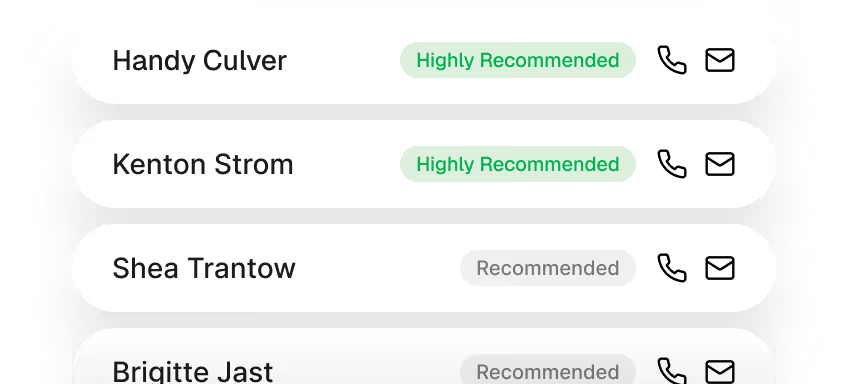
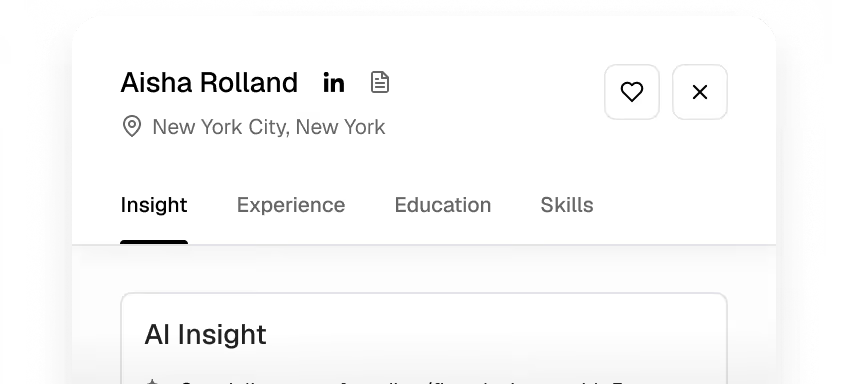
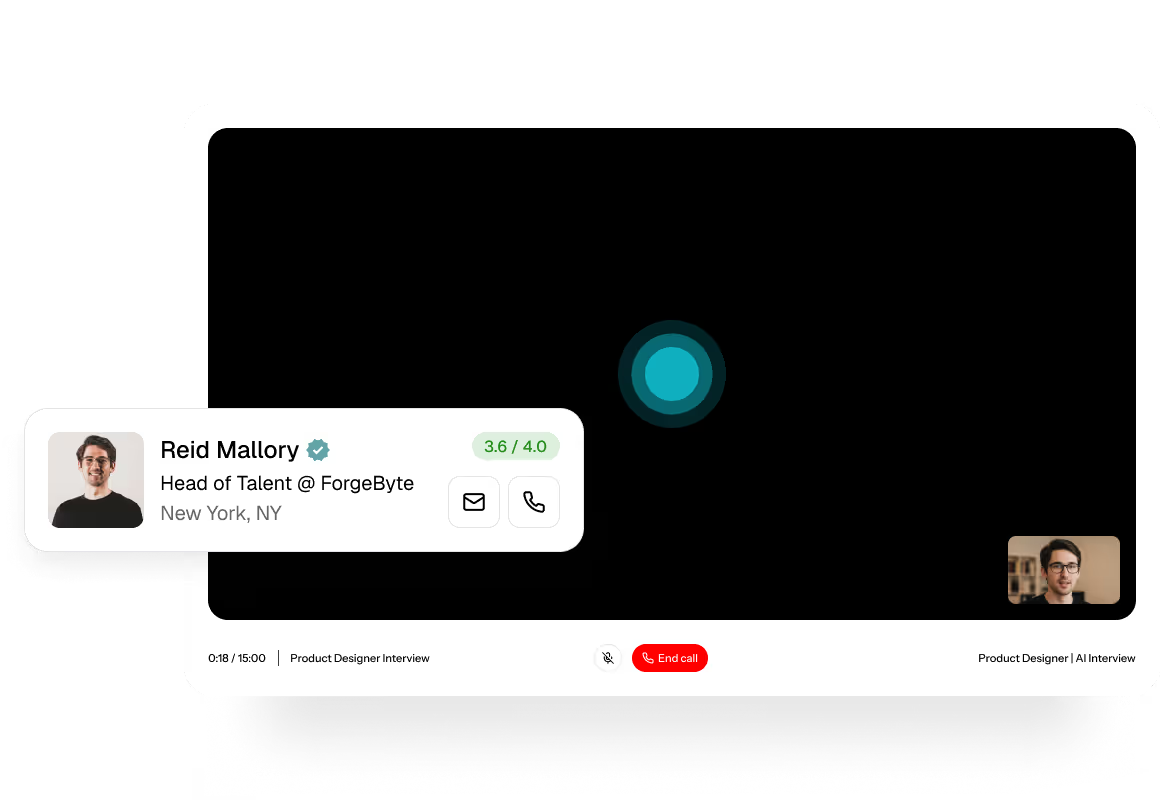
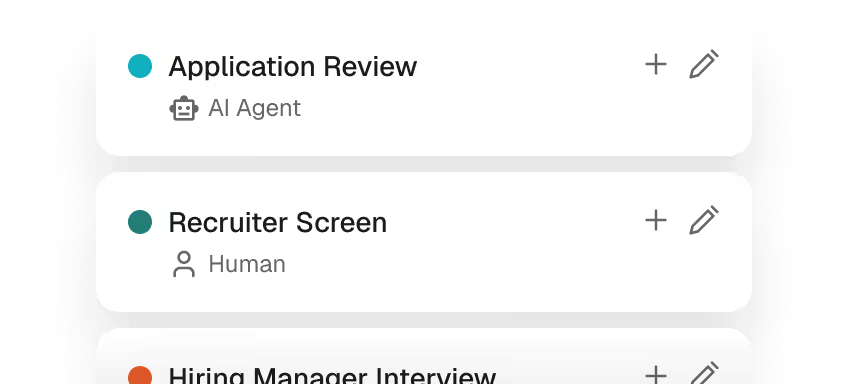
Sample shortlist entry.
That's the deliverable. A ranked shortlist, with the reasoning written next to each name and a structured interview behind every one, instead of a resume with a score out of ten.
One intake call, then a forward deployed recruiter runs the whole thing. The next time you think about this search is when the shortlist lands in your inbox.
30 minutes. Bring the role, the comp band, and how long it's been open.
vi. What you get
vii. The sixty days
| When | What happens | What you do |
|---|---|---|
| The call | 30 minutes. The role, what the market is actually paying for it, why it hasn't filled, and the exact number for that specific search. | Show up. Bring the role. |
| Intake | About an hour. We define the job, the must-haves, and put a real comp band in writing, cash plus equity. | One call. |
| Sourcing and screening | Your forward deployed recruiter goes outbound. Every inbound application read and ranked. Every candidate sits a structured interview. | Nothing. |
| The shortlist | A ranked list of finalists lands with the reasoning attached. | Give feedback inside two business days. |
| Interviews | You meet the shortlist. | Interview them. |
| Offer | We help you build it against the band we wrote at intake. | Make the call. |
| Someone starts | Your hire is in the seat. | Go back to running your company. |
| Day 90 | If they've left, or you let them go, we can run the whole search again. | Nothing. |
viii. What happens if it doesn't work
At your stage the fear isn't "this won't work." It's "I'll burn four months, end up with the wrong person, and not have the runway to fix it." The replacement covers the second half of that. We only take searches we can win, which covers the first half. Every search on our books is one we already told a founder we could fill, and you find out which category yours is in thirty minutes.
No fine print, because most of these are also the reason a search fails, and you should see them before the call.
ix. The person behind it

Kristen Habacht was VP of Sales at Trello through the Atlassian acquisition, then CRO at Typeform, then COO and President at Shogun. She's hired VPs, first engineers, first AEs and finance leads, and she's done it at the stage where getting one wrong actually hurts.
She built Elly because she was the problem. She'd take the interview, go straight into her next meeting, get twelve notifications telling her to fill out her scorecard, and just message the recruiter "yes, liked that person." Every hiring decision she made lived in her head and nowhere else.
$8M led by Sorenson Capital, built inside Atomic. Two salespeople, a small recruiting team, and a deliberate cap on how many searches run at once. You're not going to get handed to an account manager, because there isn't one.
Founders of venture-backed companies between 5 and 40 people, with a funded senior role open right now, who are currently running the search themselves. US companies, US-based hires.
No. The software is the entire business. It's the thing that makes one recruiter fast enough to charge half a search firm. You're buying a search, so judge it on the shortlist: ranked, with the reasoning attached and a structured interview behind every one.
It doesn't screen anybody out. It ranks, it shows its reasoning, and your recruiter reads the ones it ranked low too. AI filters and surfaces, a person decides. We had that part independently audited by Warden AI across more than 13,000 real interview samples, and it cleared every category they measured, published at their URL rather than ours.
The screener shows its reasoning instead of a black-box score, so you can read why somebody ranked where they did. Every candidate sits the same structured interview, which means you're comparing answers to the same questions rather than resume formatting.
Tell us on the call and you'll get an answer in 30 minutes. We only take searches we can win. If the comp band isn't inside market for that role, or the skillset is scarce at the number you can pay, you'll hear that on the call and you'll hear what number does work.
That's most of the founders we work with, and it's what the intake call is for. You tell us the job. We tell you what the market is paying for it, what a good one looks like at your stage, and where the trade-offs are.
Then the search stalls at the offer, so we settle it at intake instead. We write down what a good one looks like, you both sign off on it, and one of you owns the final call. Every candidate on the shortlist is then measured against that written bar.
Bring them. They can go through the same structured screen so they're comparable to everyone else on the list, or you can carry them separately. Just tell us on the call, because it changes the search.
Tell us what happened and who they sent. Knowing that is the fastest way to work out whether you have a sourcing problem, a comp problem or a scope problem. We won't run a second search on the same role while another firm is still working it.
Book it when the role is funded and approved. Booking early doesn't hold anything, and the call is worth a lot more when we can put a real number against a real role.
Yes. What matters is that the role is funded and approved right now.
We place US-based hires for US companies. If the seat has to sit in another country, that's not a search we run.
There isn't a trick, but there is a real constraint: one forward deployed recruiter runs your search, so we only take on so many at a time. The other one is the comp band above. We only take searches we can win, which is why the ones we take get filled.
An intake call of about an hour. Feedback on the shortlist inside two business days. Interviews with the finalists. The offer decision. That's the list.
No. Nothing to log into and nothing to configure. You're hiring a recruiter.
A forward deployed recruiter at Elly, on our own software. One person owns your search start to finish. You'll meet them on the call, and there's no account manager sitting between you and them.
We run one search at a time so the recruiter's attention isn't split. Tell us both on the call and you'll leave knowing which one to run first, and why.
We don't fill the role in 60 days, and you've spent an intake call and some interview time with people who weren't the one. You'd still have a written comp band you didn't have before, which is the floor. The one we've actually seen: the search stalls because the comp band was set before the market moved, so it turns into a comp conversation instead of a candidate problem. That's why the band goes in writing at intake, and why you hear about it in week three. ---
Book 30 minutes. We'll go through the role, what the market is actually paying for it, why it's been sitting open, and the exact number for that specific search. Then you'll know whether it's a search we can win, and you'll leave with a real comp band and the reason the role hasn't filled either way.
Sixty days. One forward deployed recruiter. A shortlist worth meeting.
Six quick questions. About 90 seconds. Then pick a time.
Six quick questions. About 90 seconds. Then pick a time.